

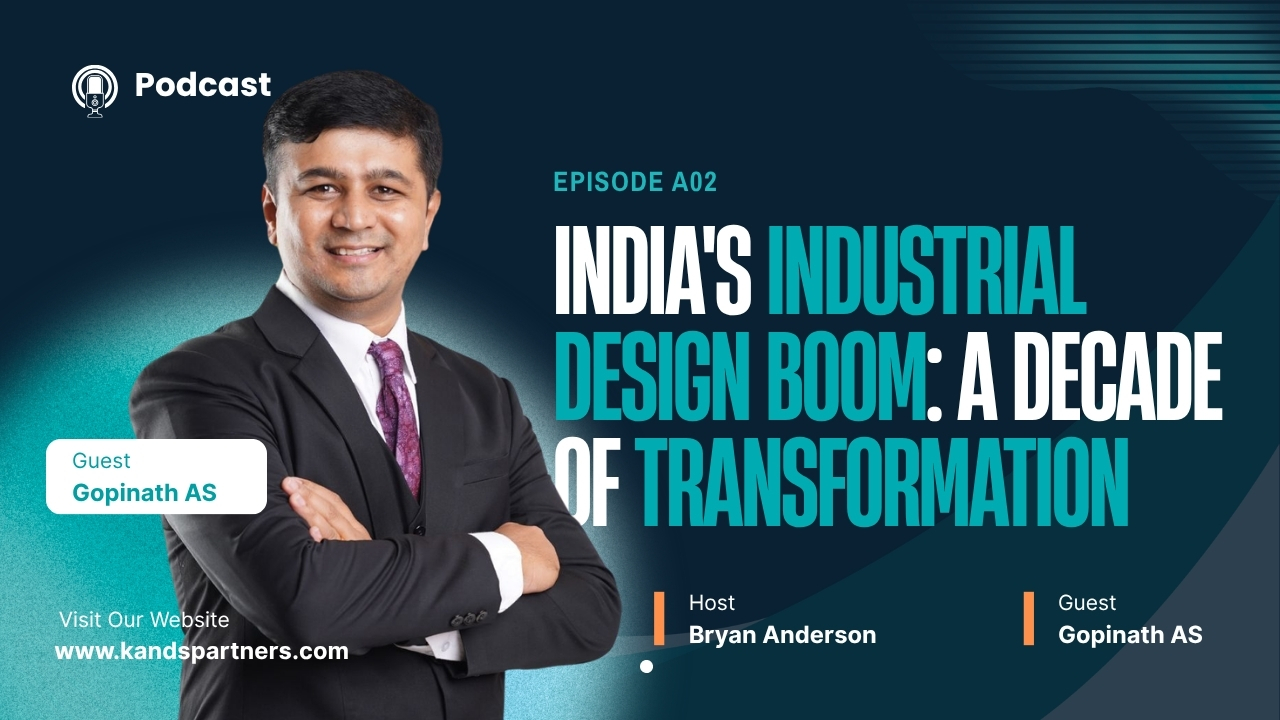
This podcast will delve into India's industrial design revolution, marked by a 266% surge in design filings since 2020. Key drivers include policy reforms, domestic innovation, faster IP processing, and the expansion of design protection to digital assets. Fashion and tech now lead filings, universities are major contributors, and upcoming legal reforms aim to boost protection for digital designs. Grassroots awareness and legislative changes are vital for India’s rise as a global design leader.
In this episode of K&S Podcast, we will discuss with Mr. Gopinath A S article authored by him titled 'Shaping the Next Decade: Industrial Design Footprint in India.'
Introduction to India’s Industrial Design Landscape
Host: Welcome to K and S Podcast Series. My name is Bryan Anderson, your host. This week we have with us Mr. Gopinath, a partner with K and S Partners, one of India’s leading IP law firms. Good morning, Mr. Gopinath! Thanks for joining us. Today we have a fascinating conversation lined up about something that touches everything from your smartphone screen to the slipper on your foot. It is about Industrial design in India. We are going to be discussing about the article authored by Mr. Gopinath titled ‘Shaping the Next Decade: Industrial Design Footprint in India.’ Welcome, and thank you for being here.
Gopinath AS: Thank you so much for having me, Bryan. This is a topic I’m genuinely passionate about, so I’m excited to dig into it.
Reflective Transformation in Indian Industrial Design
Host: Let’s start with the big picture. When you say India has undergone a ‘reflective transformation’ in industrial design over the past decade, what do you actually mean by that?
Gopinath AS: Great question to open with. For a long time, India was seen primarily as a manufacturing hub, we were building things, but the design intelligence behind those things was often coming from elsewhere. What’s changed is that India has started thinking about design as a strategic asset, not just an aesthetic afterthought. Companies, startups, even universities are now asking about how do we protect what we create visually? How do we monetize it? That shift in mindset is what I call a reflective transformation. It’s not just doing more; it’s thinking differently about what design means for business and for the economy.
Explosive Growth in Design Filings and Contributing Factors
Host: The numbers you cite are pretty staggering. A 266% cumulative rise in design filings since 2020? How do you explain that kind of explosive growth?
Gopinath AS: It really is remarkable when you see it laid out. A few things converged at the right time. First, policy played a huge role; the National IPR Policy of 2016 laid the groundwork by modernizing India’s IP infrastructure. Then you had flagship initiatives like Make in India and Startup India creating an entire generation of product-led businesses that needed to protect what they were building. Add to that the administrative improvements at the IP Office; faster processing, reduced pendency, and suddenly filing a design application became a more attractive and accessible option. And perhaps most tellingly, domestic applicants now account for nearly 90% of total design filings. This isn’t foreign companies protecting their IP in India; this is Indian businesses saying, we have something worth protecting.
Sectoral Shift Toward Fashion, Jewelry, and Lifestyle
Host: Speaking of sectors, you mention a notable shift away from traditional mechanical industries toward fashion, jewelry, and lifestyle. Can you walk us through that?
Gopinath AS: Absolutely. Historically, design filings in India were dominated by engineering-heavy sectors like machinery, hardware, automotive components. But if you look at the Locarno Classification data for FY 2023-24, the top categories are now Clothing and Haberdashery with over 3,000 applications, and Jewelry and Ornaments with nearly 1,800. That tells you something profound about where value is being created in the Indian economy today. Consumers are no longer just buying a product for its function, they’re buying an experience, a look, an identity. Brands have realized that their visual language is their competitive moat. That’s why you see someone like Sabyasachi filing over a thousand design applications in a single financial year. That’s a fashion house treating its design catalogue the way a tech company treats its patents.
Fashion Industry and IP: The Sabyasachi Paradigm
Host: That’s a great segue; Sabyasachi is a name most people associate with beautiful lehengas, not IP filings. What does it say about the industry when a fashion designer becomes one of the top design filers in the country?
Gopinath AS: It says that the creative industries have grown up, in the best possible way. For a long time, fashion in India operated on inspiration and let’s be honest, sometimes on imitation. The idea that a design could be legally protected, and that protection could translate into real commercial value, wasn’t widely internalized. What Sabyasachi has done; and the 2021 deal with ABFRL illustrates this perfectly; is demonstrate that a design library has a rupee value attached to it. That Rs. 398 crore deal attributed a significant chunk of its valuation to proprietary design assets. That’s the kind of signal that changes how an entire industry thinks.
Legal Grey Zone: Protecting Graphical User Interfaces
Host: Now, let’s talk about something you describe as a legal grey zone; the protection of Graphical User Interfaces, or GUIs. This seems like a really contentious area. What’s the crux of the issue?
Gopinath AS: So this is where things get genuinely interesting and a bit frustrating, frankly. Globally, there’s a clear trend toward recognizing GUI designs as protectable industrial designs. The way an app looks, the way a screen is laid out, the visual flow of a digital product; these are design choices that companies invest enormously in. But India’s Design Office had a very restrictive interpretation. The argument was essentially: a GUI isn’t a physical article, it doesn’t come from an industrial process, and it only appears when a device is switched on, so it doesn’t have constant visual appeal. Which, if you think about it, is a somewhat archaic way of looking at design in a digital-first world.
Judicial Pushback and the UST Global Case
Host: And then a court pushed back on that?
Gopinath AS: Yes; the Calcutta High Court in 2023, in the UST Global case, directly challenged those assumptions. The Court said GUIs can constitute visual features of an article, that embedded code qualifies as an industrial process, and that being visible during active use satisfies the eye-appeal criterion. It was a well-reasoned judgment. But here’s the odd part, the Design Office continued rejecting GUI applications even after that ruling. So you had a situation where the courts and the administration were essentially not on the same page.
Digital Design Recognition and Forthcoming Legal Reforms
Host: So where does that stand now?
Gopinath AS: There’s real reason for optimism. In January 2026, the DPIIT released a Concept Note proposing significant amendments to the Designs Act. And it’s not just GUIs; it covers metaverse assets, AR and VR interfaces, animations. The digital design world is finally being acknowledged in the legal framework. Beyond that, the proposals include a 12-month grace period after public disclosure, deferred publication, statutory damages for infringement, and even a pathway to international registration through the Hague Agreement. If implemented, this would be one of the most meaningful modernizations of India’s design law in over two decades.
Universities as Key Players in Design Innovation
Host: You also mention universities as an unexpected but major player in this ecosystem. That surprised me; can you expand on that?
Gopinath AS: It surprised a lot of people! Under the National Intellectual Property Awareness Mission, NIPAM, universities have seen a 90% increase in design filings since 2021. Institutions like IIT Delhi, NID Ahmedabad, Chandigarh University; they’ve set up dedicated IP cells, built it into their curriculum, created funding mechanisms for students to file. The implication of this is huge. You’re essentially training a generation of innovators who understand, from day one, that their creative output has legal and commercial value. That’s a cultural shift, not just an administrative one.
Economic Impact and Judicial Recognition of Design IP
Host: Let’s zoom out to the economic picture. You mention the Indian industrial design market is projected to nearly double by 2030. What’s driving that trajectory?
Gopinath AS: Several forces are converging. The demand for premium, design-centric products is rising sharply; in automotive, consumer electronics, medical devices. Medical devices alone account for over 45% of revenue share right now, which makes sense given the ergonomic and regulatory demands of that sector. But beyond market size, what’s changed is how design IP is being valued in corporate transactions. The Titan and CaratLane deal, valued at over Rs. 17,000 crores, was fundamentally a bet on a design-led identity and its library. Courts are also reinforcing this; in recent cases like Pidilite versus Astral and ; Relaxo versus Aqualite, judges have affirmed that even minor visual features, the ridges on a slipper, the shape of a container, are protectable commercial assets. That kind of judicial clarity is what gives investors and acquirers confidence.
Host: As we wrap up — what’s the single most important thing that needs to happen for India to truly become a global design powerhouse in the next decade?
Gopinath AS: If I had to pick one thing, it would be awareness at the grassroots level; particularly among MSMEs. The large corporates, the fashion houses, the IITs; they’re finding their footing. But millions of small and medium businesses are still creating designs without any protection, often not even knowing that protection exists. Closing that awareness gap, combined with the legislative reforms on the horizon, would be transformative. India has the creativity, the manufacturing base, the policy momentum; the last mile is making sure every entrepreneur with an original design idea knows how to protect it and build on it. That’s when we’ll truly see the full potential of ‘Design in India, Design for the World.’
Closing Reflections and Thank You
Host: Beautifully put. Thank you so much for this conversation; it’s given us a lot to think about.
Gopinath AS: My pleasure. Thank you for the thoughtful questions.